Thursday, 29 November 2012

Seventh.

This recent posts have focused on the adaptability of dinosaurs to survive climate change; this one will examine how it could have wiped them out. The Deccan Traps, India, was an area of intense volcanism towards the end of the Cretaceous, caused by the northward movement of India over the Reunion hotspot. Covering over 512000 km² today after erosion, the original lava flows would have spanned nearly three times as much (Keller, 2011). Operating over one million years, three distinct phases of volcanicity can be attributed to the flow, the largest being the second phase, right at the K/T boundary (Keller, 2011) 


The problem with associating the Deccan Traps to the end Cretaceous mass extinction is the fact that there are recovery periods between each phase, as well as the lack of significant marine microfossils interbedded within the traps, as they are a good indicator of mass extinction events (Keller, 2011).  However, comprehensive data collection at the volcanism site by Keller et al. (2011) has yielded more information on the exact nature of the event.

Microfossils were found in quarries along the K/T boundary, and showed the devastating impact of the volcanism of these tiny marine organisms:


The fossils found here were concordant with fossils found at other localities with known volcanicity, showing a high-stress low-diversity assemblage (Keller, 2011), in what is known as the "Lilliput effect". In addition, gas concentrations were calculated, after being preserved in rare bubbles within the rock. The concentrations of carbon and sulphur dioxide was beyond any anthropogenic induced change seen today, whilst evidence of a 'cooling' stage would have increased weathering, thus compounding the adverse effect of the gases. Keller (2011) writes:


Relating to dinosaurs, Keller (2009) wrote in an earlier paper how the last known remains of the reptiles are found before the significant lava flows at the K/T boundary, between the first and second phase, and show no signs of recovery after. It is plausible, therefore, that the Deccan traps had some effect on the giant reptiles. The theory of mass volcanism should not be disregarded in favour for the Meteor Impact theory, rather the meteor was the final straw in an already stressed environment, thanks to the volcanism. 
  

http://filebox.vt.edu/artsci/geology/mclean/Dinosaur_Volcano_Extinction/media/cretdawS.gif
http://www.science-story.com/images/deccan-traps.jpg
Keller G, Sahni A and Bajpai S 2009 Deccan volcanism, the KT mass extinction and dinosaurs; J. Biosci. 34 709–728
Keller et al. 2011.Deccan Volcanism Linked to the Cretaceous-Tertiary Boundary Mass Extinction: New Evidence from ONGC Wells in the Krishna-Godavari Basin. JOURNAL GEOLOGICAL SOCIETY OF INDIA Vol.78, November 2011, pp.399-428 


Saturday, 24 November 2012

Sixth.

GSD vs TSD. Probably not something you come across everyday. In a (relatively) recent article Miller and his team (2004), the sex determination of organisms, including dinosaurians, was analysed:


 Sex determination is essentially how a male or a female is allocated its sex during its embryo stage of development. GSD, or genetic sex determination, uses sex chromosomes (X and Y) or genes (such as SRY gene in mammals) to produce a male or female foetus. In TSD organisms, temperature plays a key role, above or bellow a certain temperature produces one of the two sexes, a trait seen in alligators and turtles, for example. The sex determination methods in dinosaurs cannot be known due to the nature of the fossil record, however it can be inferred via their phylogenetic relationship to other animals. 

The above graph shows the sex determination method in animals and their phylogenetic relationship. Dinosaurs, being archosaurs, are close relatives of crocodiles, which use TSD to determine offspring sex. Further evidence is found in the offspring, as dinosaur and alligator infants share well developed prenatal pelvic girdles, inferring a similar nesting style in both groups.  

At the K/T boundary, famed for the extinction of the dinosaurs and 65% of life on earth, undoubted climatic change occurred, after millions of years of favourable climates that meant dinosaurs had no need to switch to GSD. A change in temperature skewed the sex ratio of the dinosaurs towards a male-based environment, thus causing an impossible recovery from the events at the K/T boundary

However, this article is filled with inaccuracies. Firstly, there is no concrete proof for TSD in dinosaurs, and the evidence Miller (2004) has suggested is wrong: he writes that dinosaurs had a reptilian breathing mechanism rather than an avian one, thus circulation was more likely to resemble ectothermic crocodilians. However, as in my last post, dinosaurs are seen to have avian style breathing, and were in fact probably exothermic creatures. Thus, GSD could have arisen in dinosaurs in the same way as it arose in birds, rendering the argument obsolete.

http://www.infertile.com/pdf_files/archive/2004_FertStert_EnvironmentalSex.pdf 

Thursday, 22 November 2012

Fifth.

Apologies for the absence, a few projects cropped up that needed my attention. This blog will be looking at how fluctuations in atmospheric oxygen levels may have had an influence on evolution, which caught my attention thanks to an article written by Berner and his colleagues (2009):

 Throughout history there have been fluctuations in global oxygen levels, whose cause can be attributed to tectonic activity capturing carbon dioxide into underground carbon stores, volcanism spewing out a cocktail of gases into the atmosphere and, perhaps fundamentally, the evolution of photosynthesising organisms, who produce oxygen as a by product. Thus, organisms have to adapt accordingly, in order to maintain and regulate their environment in what is known as the 'Gaia Hypothesis'. 

 The above graph comes from Berner et al's (2009) article, showing atmospheric oxygen levels during the Phanerozoic, noting that several extinction events coincide with decreasing oxygen levels, such as at intervals 5 (Devonian), 9 (Permain-Triassic) and 11 (Triassic-Jurassic) on the graph. Berner (2009) denotes four major events relating to evolution and oxygen:
  1. The origin of the first animal body plans coincides with an increase in oxygen (interval 1).
  2. Two independent phases of high oxygen levels relate to the conquest of animals on to land, interval 4 showing the first of these conquests, mainly achieved by arthropods, and interval 7, which included the vertebrates.
  3. The all time oxygen high during the Carboniferous and Permain (8) may have caused gigantism in several arthropod groups including the dragonflies and millipedes, whilst an overall increase in body size is seen in many vertebrate groups. 
  4. Interval 12 may have caused the increase in mammalian body size during the tertiary.
However, the mechanisms of these points are unclear, however the presence of high oxygen levels is seen to influence size in trout (Dabrowski, 2004), and alligators (VandenBrooks, 2007).

The decrease in atmospheric oxygen during the late Triassic (interval 10), coincides with the rapid diversification of dinosaurs. This may have been due to a novel mechanism used by these organisms to extract oxygen in low oxygen conditions, and is retained by birds today due to its usefulness during high altitude flight. Known as the pulmonary air sac system, fossilised dinosaur bones are seen to have air filled spaces, where the bone has been invaded by the aforementioned system (O'Connor, 2005). Essentially, these air sacs means that inhaled air in effectively passed into the lungs twice via a bellow system, extracting as much oxygen as possible from one breath. Thus, dinosaurs had a respiratory advantage compared to other terrestrial organisms at the time, causing their rise and diversification as dominant land animal for 150 million years. 


Berner et al, 2009- http://webh01.ua.ac.be/funmorph/raoul/fylsyst/Berner2006.pdf
K. Dabrowski, K. J. Lee, L. Guz, V. Verlhac, J. Gabaudan, Aquaculture 233,383 (2004). 
J. M. VandenBrooks, thesis, Yale University (2007). 
Patrick M. O'Connor & Leon P. A. M. Claessens (2005) Basic avian pulmonary design and flow-through ventilation in non-avian theropod dinosaurs Nature 436, 253-256
http://michigantoday.umich.edu/2008/10/aero1-lg.jpg


Saturday, 27 October 2012

Fourth.


Evening ladies and gents. Today's blog will look at how a species evolved in changing climatic conditions to become one of the top predators in its habitat, and it is not a mighty tyrannosaur that takes centre stage. Its a smaller theropod who goes by the name Troodon. Lets start off with the basics. By definition, members of the Troodon are small, bipedal carnivores, best known for their large brains and inferred cerebral capabilities. Found during the late Cretaceous, they weighed in at no more than 50kg. That's about twenty times smaller than the Gorgosaurus  (centre right) in the picture above. It was their brain power that gave them a vast predatory arsenal, using speed and communication to hunt.

However, during the Maastrichian, climate fluctuations meant that the polar regions got colder and saw less daylight (Wolfe and Upchurch, 1987). And as a general rule, the colder it gets, the fewer predators you come across. This can be seen in Alaska's fossil record: fewer than one percent of the 3000 bones collected there show predator tooth marks (Gangloff, 2012). However, of the predators found in the arctic circle, Troodon is very well represented. This is where it gets interesting. The teeth this far north are twice as big as those found south. That means where looking at predators twice as big as they should be: nearing the 100kg mark. 

Now, I'm not saying that these larger Troodon are the same species as their southern representatives, but they are of the same tribe, and thus extremely similar. This shows how climate has affected the small theropod, and it has responded accordingly. It's already large eyes meant it had no problem hunting in the perpetual night that surrounds the area for most of the year. And the probable feathered covered skin helped with heat retention. The interesting morphological change is the doubling of its mass. Surely having more mass means larger energy expenditure? It probably is the case.  But being larger helps with heat rentention, as they now possess a smaller surface area to volume ratio compared to their smaller cousins. Put a feather coat on top of that and they were pretty toasty.

This doubling in size also means that it can tackle larger prey, which was abundant for the same body heat retention (check out the gigantothermy model for more info). Working together to haul down large Edmontosaurus for example, meant that Troodon was king of the Acrtic.


-http://blogs.smithsonianmag.com/dinosaur/files/2011/05/March-of-the-dinosaurs-promo.jpg
-http://www.clim-past-discuss.net/4/981/2008/cpd-4-981-2008.pdf
-Fiorillo, Anthony R.; Gangloff, Roland A. (2000). "Theropod teeth from the Prince Creek Formation (Cretaceous) of Northern Alaska, with speculations on Arctic dinosaur paleoecology". Journal of Vertebrate Paleontology 20(4): 675–682.
-http://books.google.co.uk/books?id=iriTYIpQV4IC&pg=PA100&lpg=PA100&dq=arctic+troodon+teeth&source=bl&ots=Q-pNtJu30w&sig=0DZe0Hcu99BPegpe_tChXLdhUEU&hl=en&sa=X&ei=bRuMUNitBebO0QXE1YDgDQ&ved=0CEIQ6AEwBQ#v=onepage&q=arctic%20troodon%20teeth&f=false
-http://3.bp.blogspot.com/-WbOR1Wk4x7E/UBspJOtFc-I/AAAAAAAABGE/zFaPmA2U0yk/s640/alaska2.png

Saturday, 20 October 2012

Third.


After trolling the web for more tasty climate related dinosaur fun, I came across this pearler:


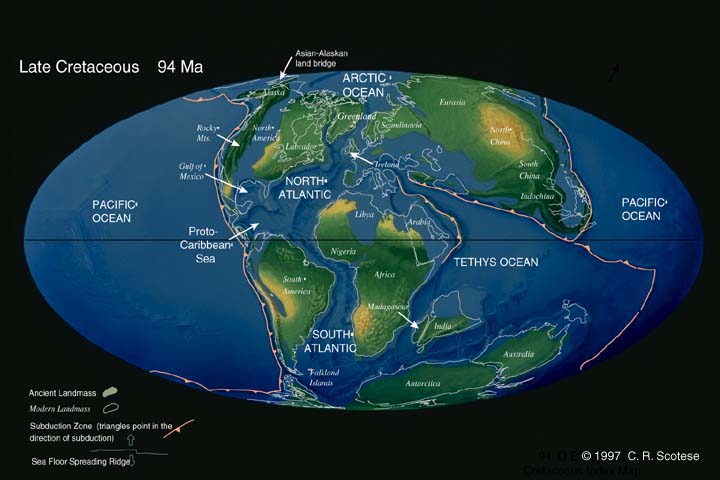
Aha, I hear you say. What has that got to do with climate change and dinosaurs? Well, its pretty simple. And it makes a nice change to all that "massive asteroid explosion" theory we learnt when we were six. The late Cretaceous was a changing time, geological speaking, with several mountain building episodes, with many of the shallow seas drying up, as denoted by the red lines on with map, indicating the major subduction zones:


This lead to a massive drop in temperature, decreasing by around ten degrees. That kind of temperature drop is felt on a global scale. Dinosaurs are mainly found in warm and warm temperate zones (Figure 1.), and after studying their depositional environment, paleoecology and stomach contents of the herbivorous species, their preferred habitats are often associated with open grassland and marshland (Krassilov, 1981). As mountain building increased, and shallow seas disappeared, an increased seasonality occurred, favouring a particular group of plants: conifers.

Figure 1, Krassilov (1981). A= Northern temperate; B=Warm-temperate; C=Warm. Top Image: Jurassic. Lower Image: Cretaceous.

Van Valen and Sloan argued that dinosaurs were maladapted to these new forests, and migrated towards the tropics, supported by Krassilov's work mentioned above. However, the two papers differ in opinion on what exactly caused the extinction. Climate change is ubiquitous in both arguments, however Krassilov believes that the elimination of shrub land/marshland meant that the dinosaurs effectively died of starvation. Van Valen and Sloan argue however that the rise in in conifer forests lead to an unimpeded rise in mammal populations, as the dinosaurs did not venture into those areas, reducing competition.  These new mammal herbivores then descended from their conifer forest environment to plunder the dinosaur territories, leading to gradual extinction.

However, in my opinion, there are problems. In Van Valen's paper, he is effectively saying that herbivorous dinosaurs, multi tonne beasts, were out-competed in their territory, by newly radiated mammal species. It just doesn't seem plausible, as surely they were not big enough to oppose the late Cretaceous dinosaurs, and there carnivores roaming around who probably wouldn't have minded adding "mammals' to their diet. Also, it doesn't explain the extinction of the marine reptiles and pterosaurs, as well as several thousand marine invertebrate species either. What I think we should take from this paper is that dinosaur extinction was not as brutal as Alvarez and his team made it out to be with the impact crater theory.

And I leave you with this hilariously terrible image from Krassilovs paper. Is a Triceratops? Is it a turd? You decide.


http://www.scotese.com/images/Cretac94.jpg
http://www.paleobotany.ru/PDF/1980-1989/Krassilov_1981_changes.pdf
http://animals.howstuffworks.com/dinosaurs/dinosaur-extinction4.htm
Robert E. Sloan, J. Keith Rigby, Leigh M. Van Valen and Diane Gabriel. Gradual Dinosaur Extinction and Simultaneous Ungulate Radiation in the Hell Creek Formation Science, New Series, Vol. 232, No. 4750 (May 2, 1986), pp. 629-633 


Sunday, 14 October 2012

Second.

What better place to start my first "proper" blog post about dinosaurs and climate change than the following newspaper article:


Telegraph, 2012

At first I was sceptical about it, I labelled study leader Dr. Wilkinson as a embarrassment to palaeontology. The notion is just ridiculous: dinosaurs farted so much they caused global warming. But as I began to read it, I realised the bloke had a point. Lets start at the basics. Cows are herbivores. They eat grass. Grass contains cellulose an indigestible compound that can only be broken down by the enzyme cellulase, found in bacteria. So it's pretty handy that cows, along with other ruminants, have a gut full of the microbes. As the cows eat the grass, the plant matter ferments in the anaerobic conditions of the gut, producing methane. Simple. It is estimated that modern day herbivores account for 45 to 90 million tonnes of methane per year. 

Wilkinson, 2012

Cows, compared to the majority of dinosaurs, are insignificantly small. Sauropods, measuring up to 40m in length and a anything above 40 tonnes in weight, would have had gut flora unlike anything seen in modern day ecosystems. And their cellulose digesting bacteria had a huge daily income of plant matter entering the enormous digestive cavity. After doing a clever bit of maths, Dr. Wilkinson estimated that the animals produced around 472 million tonnes of methane per year. Today's total of natural and man made emissions: around 181 million tonnes per year. 


According to the study, Sauropods alone would have been responsible for adding an atmospheric concentration of 1-2 parts per million. And this is without adding the ceratopsians, hadrosaurs, ankylosaurs, nodosaurs,stegosaurs, heterodontosaurs, just to name a few, to the mix.

The moral of this story is: to prevent global warming, kill all large herbivores. Sucks for you, Mr. Elephant...

http://www.telegraph.co.uk/science/dinosaurs/9250032/Dinosaurs-passing-wind-may-have-caused-climate-change.html


https://blogger.googleusercontent.com/img/b/R29vZ2xl/AVvXsEhyO1rqqFX6qTC9vtOqY04DysIMIanafNGWkJIfttEz_HqVlIV5_qKYVs0bzotxa8zWmmdYyLlTPBtlwp8id_Y0jG1ULimGjbc4zCb8SNAltmHcpMVBgwowprVgKJdLs_DfzNVCNRQcrvE/s400/sauropods.jpg

Thursday, 11 October 2012

First.

Right then. As some of you may know, I like Dinosaurs. A lot. Unfortunately, I'm doing a degree where we don't often get to talk about them. Which is ironic, as my degree is in palaeobiology. Accordingly, I'm going to use this blog as a place to bathe in the delicious warm glow of my favourite subject, something that my university hasn't done.

I'm going to be trolling through the web in search of how environmental change has affected the beasts, looking at newspaper articles and scientific journals, in an attempt to bring in the best news and views from around the internet. I might even throw in a few of my opinions too.

http://25.media.tumblr.com/tumblr_m7a2na65Od1rsiohpo2_1280.jpg